
If you've ever had to submit a translated document to a government body, a court, or a foreign authority, you've probably run into a wall of unfamiliar terms. "Certified translation." "Notarized." "Apostille." Sometimes the requesting authority specifies exactly what they want. Often, they don't.
Getting this wrong is an expensive mistake. Submit the wrong certification tier and your document gets rejected. Over-certify and you've paid for a legal process you didn't need. Neither outcome is good when you're working to a deadline.
Here's a clear breakdown of each certification type, what it actually means, and how to figure out which one applies to your situation.
The Four Certification Tiers, Explained Simply
Think of these as a ladder. Each step up adds a layer of formal verification — but that doesn't mean you always need to climb to the top.
Agency Stamp: The Standard Starting Point
An agency stamp — sometimes called a certified translation — is what most people picture when they hear "official translation." It comes with a signed statement from the translation provider confirming that the translation is accurate and complete.
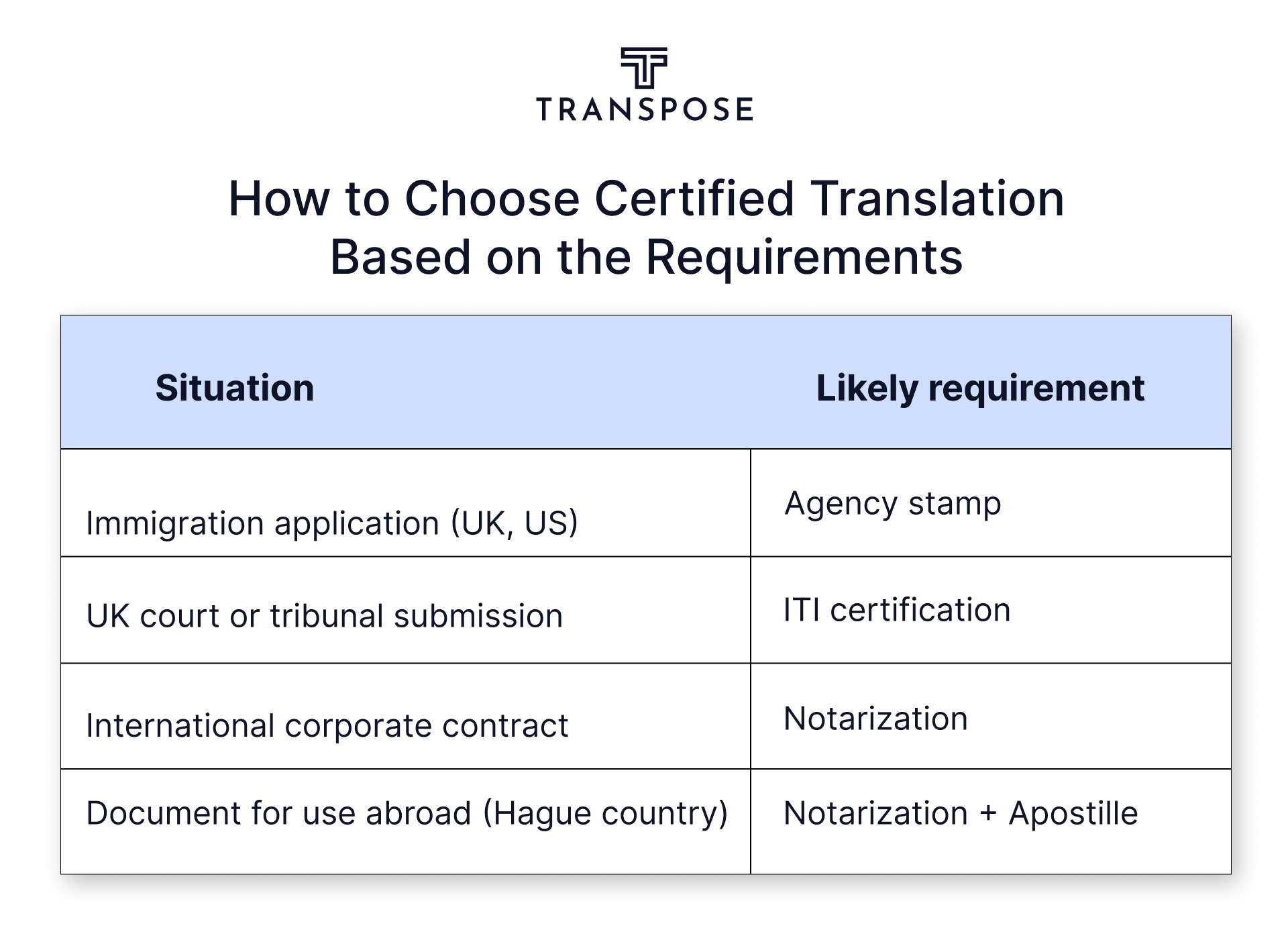
This is the baseline level of professional authentication. For a wide range of purposes — immigration applications, administrative filings, standard corporate documents — it's entirely sufficient. Bodies like the UK Home Office and USCIS in the United States routinely accept translations at this level.
What the stamp represents is professional accountability. The agency or translator is putting their name to the work and confirming it accurately reflects the original. It's a formal quality assurance — just not a legal one.
Good for: Immigration documents, standard administrative procedures, routine corporate filings, HR records.
👉 You might also like to read: Differences Between Professional Translation Agency and Freelance Translator: Which One to Choose?
ITI Certification: When You Need Proven Professional Credentials
The Institute of Translation and Interpreting (ITI) is the UK's leading professional body for translators and interpreters. Qualified members — those holding MITI or FITI status — have passed rigorous peer-reviewed assessments before being admitted. The ITI stamp can only be applied by these accredited members.
👉 You might also like to read: Why ITI Membership Matters for High-Stakes Business Translation Deals
This matters particularly in the UK context. Unlike many European countries, the UK has no state-appointed "sworn translator" system. The ITI stamp fills that gap. It's the recognized mark of professional competence for high-stakes translations destined for courts, government agencies, and formal legal proceedings.
👉 You might also like to explore:
- What Is Legal Translation? Definition, Types, and Importance
- What is Legal Translation Service and What Does It Include?
If a receiving authority asks for a translation by a "qualified" or "accredited" professional — and they don't specify further — ITI certification is typically what they mean.
Good for: UK court submissions, immigration tribunals, formal legal proceedings, corporate contracts where the receiving party requires evidence of translator competence.
Notarization: Identity Verification, Not Quality Verification
This is where a lot of confusion starts. Notarized translation sounds like the most rigorous option, and in terms of legal formality, it is. But it doesn't do what many people assume.
When a translation is notarized, the translator signs their declaration of accuracy in front of a Notary Public. The Notary then signs, stamps, and seals the document. What they're certifying is the identity of the person signing — that the person claiming to be the translator is who they say they are.
The Notary does not check the translation itself. They're not a linguist. Their role is purely to authenticate the act of signing, not to verify whether the translation is accurate or professionally produced.
This is an important distinction. Notarization adds legal weight to the document by creating a verified chain of identity. For many international legal processes — powers of attorney, corporate contracts, documents used in foreign proceedings — notarization is a mandatory step, not an optional upgrade.
Good for: International corporate contracts, powers of attorney, legal proceedings in jurisdictions that require notarized documents, documents intended for legalization.
👉 You might also like to read: Sworn, Notarized, Certified, and Official Translations: Understanding the Differences
Apostille: The Final Step for International Use
An Apostille is an official government certification that sits on top of notarization. It authenticates the Notary's signature for use in countries that are party to the Hague Convention.
In the UK, Apostilles are issued by the Foreign, Commonwealth and Development Office (FCDO). The Apostille doesn't comment on the content of the document. It simply confirms that the Notary who signed it was legitimate — which is what the receiving country needs to accept the document as valid.
The typical chain for international use looks like this: certified translation → notarization → apostille. Each step builds on the last.
Not every international document needs to go this far. But if you're submitting documents in a Hague Convention country and that country requires full legalization, there's no shortcut.
Good for: Documents for use in foreign jurisdictions, international corporate transactions, cross-border legal proceedings, government submissions abroad.
How to Choose the Right Level for Translation
The honest answer is: ask the organization requesting the translation before you commission anything.
The ITI recommends getting written instructions from the receiving authority before selecting a certification tier. This isn't bureaucratic caution — it's practical. Requirements vary by country, by authority, and sometimes by document type within the same jurisdiction. What a Swiss commercial court accepts may differ from what a UAE government ministry requires.
As a general guide:
When in doubt, it's worth choosing a translation provider — like Transpose — that can handle all four tiers. That way, if requirements change or you need to upgrade the certification after the fact, you're not starting from scratch with a different provider.
What Transpose Offers
Transpose provides the full range of certification options for corporate, financial, and legal documents:
- Agency stamp — standard certified translations for administrative and routine corporate use
- ITI certification — through accredited members of the Institute of Translation and Interpreting
- Notarization — for documents requiring formal legal verification of the signing
- Apostille — for international use in Hague Convention countries
All translations are completed under ISO 17100-certified processes, with documents handled through Swiss-hosted, secure infrastructure. If you're working with confidential contracts, legal filings, or sensitive financial records, the certification question and the data security question both have answers in the same place.
If you're not sure which certification level your document needs, get in touch with the Transpose team — they'll help you identify the right option before you commission the work.
Transpose.ch provides certified translation services for corporate, legal, and financial clients. Alongside our Swiss-hosted datarooms and ISO 17100-certified processes, we offer a full range of certification options, including our agency stamp, ITI certification through the Institute of Translation and Interpreting in the UK, notarisation, and apostille for international use. These options are designed for organisations that need reliable, confidential translations accepted across borders. Email us at trp@transpose.ch or call +41 22 839 79 79 to discuss your requirements.