
Transliteration changes text from one writing system to another while keeping the sound of the original word. It does not explain or change the meaning. Instead, it helps people pronounce words written in unfamiliar scripts.
This means someone can say a word correctly even if they cannot read the original alphabet.
For global businesses, transliteration is important. It keeps names, places, and technical terms consistent across documents in many languages. Clear transliteration also reduces mistakes in official paperwork and digital systems.
In this post, we will explain how transliteration works, when it is needed, and provide some examples.
What Does Transliteration Mean?
Transliteration is the process of writing a word from one alphabet or script using another alphabet. The goal of transliteration is to match the sound of the original word as closely as possible. Each sound or letter is replaced with the nearest equivalent in the new script.
For example, the Russian word “Москва” becomes “Moskva” in Latin letters. The meaning does not change. But now English speakers can say the word even if they cannot read Cyrillic.
This makes transliteration especially helpful for travelers, readers, and businesses working with multilingual data.
Here are the key features of transliteration:
- Focuses on sound, not meaning
- Keeps the original pronunciation
- Follows letter-for-letter or sound-for-sound rules
- Keeps proper names and technical terms accurate
- Makes foreign words readable in another script
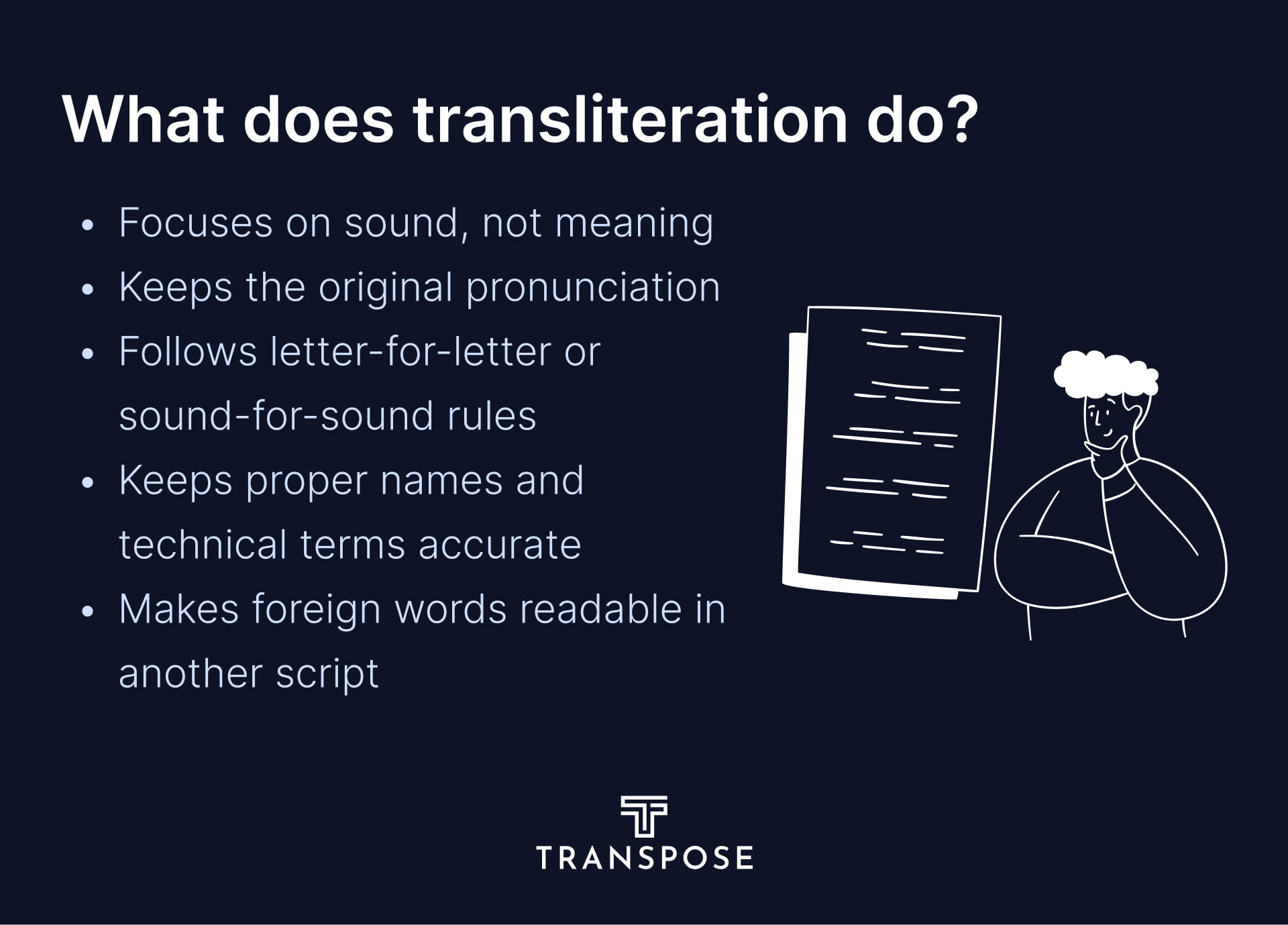
These transliteration features help ensure that important names and terms stay recognizable no matter what language your audience speaks.
Transliteration vs. Translation: What's the difference?
Translation converts the meaning of text from one language into another. Transliteration, on the other hand, changes the writing system while keeping the original pronunciation the same.
Think of transliteration as “how it sounds,” and translation as “what it means.”
Example:
- Translation: “こんにちは” → “Hello”
- Transliteration: “こんにちは” → “Konnichiwa”
Transliteration examples
Transliteration appears in many business documents. Here are common examples:
Personal and company names:
Arabic: محمد → Muhammad
Chinese: 李明 → Li Ming
Greek: Παπαδόπουλος → Papadopoulos
Hebrew: דוד → David
Japanese: 田中 → Tanaka
Geographic locations
Russian: Санкт-Петербург → Sankt-Peterburg
Thai: กรุงเทพฯ → Krung Thep
Korean: 서울 → Seoul
Hindi: मुंबई → Mumbai
The same word may also have several valid transliterations. For example, the capital of China can appear as Beijing (modern Pinyin) or Peking (older Wade-Giles).
Romanization
Romanization is a specific type of transliteration that refers to converting text from any non-Latin script into the Roman (Latin) alphabet (the one used by English, Spanish, French, etc.).
So while transliteration is the broad term for converting between any two scripts, Romanization specifically means the target script is always Latin.
Examples:
- Arabic "مرحبا" → "marhaba" (Romanized)
- Chinese "北京" → "Beijing" (Romanized)
- Russian "Москва" → "Moskva" (Romanized)
- Japanese "東京" → "Tokyo" (Romanized)
All Romanization is transliteration, but not all transliteration is Romanization. Transliteration from Arabic to Russian, for example, is not Romanization because the target script is Cyrillic, not Latin.
When transliteration is needed?
Transliteration comes into play whenever you want to show how a word from another writing system should sound using the Latin alphabet. Instead of translating meaning, it helps you reproduce pronunciation. This is especially handy for names, brands, and terms that keep their identity across languages.
Transliteration also makes foreign words easier to type into tools or platforms that only handle Latin characters.
Here are the common cases when you need transliteration:
For names and titles
Any time you mention a person, place, or brand written in a script like Cyrillic, Arabic, or Chinese, transliteration helps readers pronounce the word even if they can’t read the original writing.
For technical terms or cultural references
Some words carry a sound or concept that doesn’t translate cleanly. In those cases—like film titles, traditional dishes, or cultural concepts—transliteration preserves how the word is spoken.
To help with pronunciation
If someone needs to pronounce a word from another script, writing it in Latin characters gives them a clear guide. This is useful for learners encountering unfamiliar alphabets.
For cross-language data and search
When databases or digital systems only support the Latin alphabet, transliteration allows you to enter and retrieve information from non-Latin languages without losing accuracy.
When meaning isn’t the goal
Transliteration focuses entirely on sound, not definition. If your goal is to express what a word means, you should translate it instead. For example, transliterating ありがとう gives you “arigatou,” while translating it gives you “thank you.”
Key ISO Standards for Transliteration
Many scripts around the world are converted into Latin characters according to published standards by the International Organization for Standardization (ISO). These standards ensure consistency when you transliterate names, titles or terms from one writing system into the Latin alphabet.
ISO 9 (Cyrillic → Latin)
The standard ISO 9:1995 provides a one-to-one mapping of Cyrillic characters (used for languages like Russian, Ukrainian, Bulgarian and others) to Latin characters. It’s designed to allow a faithful representation of the original spelling — even enough that you could convert back if needed.
ISO 233 (Arabic → Latin)
For Arabic script, the standard ISO 233:1984 sets out how to convert Arabic characters into Latin so that they can be processed in databases or cited in international publications. There is also a simplified variant, ISO 233‑2:1993, which makes transliteration easier for library catalogues and indexing.
ISO 259 (Hebrew → Latin)
The standard ISO 259:1984 handles how Hebrew characters can be represented in Latin. It supports unambiguous conversion of Hebrew letters so they can be processed in multilingual documentation.
ISO 843 (Greek → Latin)
The standard ISO 843:1997 covers transliteration (and in some cases transcription) of Greek characters into Latin script. It provides both strict character-to-character mapping and a phonetic variant for modern Greek.
Do you have documents that require professional translation?
At Transpose, we provide secure, certified translations tailored for corporate companies, law firms, and financial and consultancy firms. Your documents are stored safely in Swiss-based datarooms — no redaction needed. Certified translations are available with Agency, ITI, notarization, and apostille options, all meeting ISO 17100 and 18587 standards. For a consultation or quote, email us at trp@transpose.ch or call +41 22 839 79 79 today.
Services & resources to explore
- Sworn Translation - Court-accepted translations with verified transliteration of legal entity names
- Apostille Translation - International document authentication with consistent name rendering
- Technical Translation: Definition and Examples - Learn about transliterating technical terms and specifications
- Cultural Sensitivity in Translation - Understanding cultural factors in name transliteration
- Multilingual Content Marketing Strategy – Understanding the nuances of a global content marketing strategy