
Certified translations turn your documents into legally valid records that courts, government offices, and various institutions accept around the world.
This guide walks you through the questions people and businesses most often have about certified translations. You’ll get a clear understanding of what actually makes a translation “certified,” when it’s required, and how to choose the type of certification that fits your needs.
1. What is a certified translation?
A certified translation is a translated document that comes with a signed statement from the translator or the translation agency confirming that the translation is accurate and complete. This statement usually includes the translator’s credentials, their signature, and the date it was finalized.
Unlike a regular translation, a certified translation carries legal authority because the translator takes full responsibility for its accuracy. That means you can submit these documents directly to courts, immigration offices, or regulatory agencies without needing extra verification because a translator (or a translation agency) signs a statement confirming that the translation is a full, accurate rendering of the original document.
A proper certified translation includes:
- A full translation of all visible text, including stamps and seals
- A signed declaration stating the translation is accurate
- The translator’s name, signature, and qualification details
- The date the translation was completed
- A company seal or stamp (when provided by a translation agency)
2. What kinds of documents commonly need certified translation?
If a legal, governmental, educational, or administrative institution needs an official document in a specific language, there’s a good chance they’ll ask for a certified translation.
These documents typically include birth, marriage, and death certificates; academic diplomas and transcripts; legal documents such as contracts or court rulings; immigration and visa paperwork; medical reports; identity documents; and other formal records.
3. Are locally certified translations accepted internationally or by other countries?
It largely depends on the country you’re submitting documents to and the specific requirements of that institution.
A locally certified translation can be accepted internationally, but only if it matches the standards of the country or institution receiving it. Some countries require sworn translators, others may ask for notarization or even an apostille.
In many English-speaking or “common law” countries—such as the U.S., U.K., or Australia—a translation that includes a signed accuracy statement from the translator (with their name, signature, date, and contact details) is usually sufficient for legal or administrative purposes.
However, many European or “civil law” countries, including France, Germany, and Spain, often require translations completed by a sworn or officially authorized translator, rather than a general certified translation issued by any translator or agency.
4. What is the difference between “translation” and “certified translation”?
A standard translation simply converts text from one language to another. It’s useful for everyday purposes—like personal understanding, basic communication, or internal use—but it doesn’t include any formal confirmation of accuracy or legal validity.
A certified translation, on the other hand, is created specifically for official or legal use. The translator provides a signed statement confirming that the translation is accurate and complete, which gives the document legal credibility. Institutions that require an official language equivalent—such as courts, government offices, or educational bodies—typically ask for this type of translation.
5. What is “notarized translation” or “apostille / legalized translation,” and how do they compare with certified translation?
A notarized translation is one where a notary public (or similar official) notarizes the translator’s certification statement or signature. The notary’s role is not to verify the accuracy of the translation—they simply confirm the identity of the person signing the statement. In other words, the translation itself isn’t reviewed; the signature is.
An apostille or legalized translation is required when a translated document will be used abroad, particularly in countries that follow the Hague Apostille Convention. This process may involve several steps: the translation is certified, then notarized, and finally legalized by the appropriate authority so it can be recognized internationally.
You might want to check: Hague Apostille country list
Whether you only need a certified translation, or you also need notarization or legalization, depends entirely on the rules of the country or institution receiving your documents. It’s always best to confirm the requirements in advance.
6. When do you need certified translation?
You’ll need a certified translation any time you submit a foreign-language document to an official institution—whether it’s a government agency, court, university, or regulatory body. Most organizations require certification to verify that the document is authentic and to prevent fraud.
Certified translations are commonly needed for visa applications, university admissions, business registrations, patent filings, and court cases. HR teams also rely on certified translations when hiring international employees or reviewing foreign qualifications.
Documents that typically require certification include:
- Birth certificates, marriage certificates, and divorce decrees
- Academic transcripts and diplomas
- Legal contracts and court documents
- Medical records for international treatment
- Financial statements for global transactions
- Patent applications and technical specifications
- Immigration documents and visa applications
7. What's the difference between certified, sworn, and notarized translation?
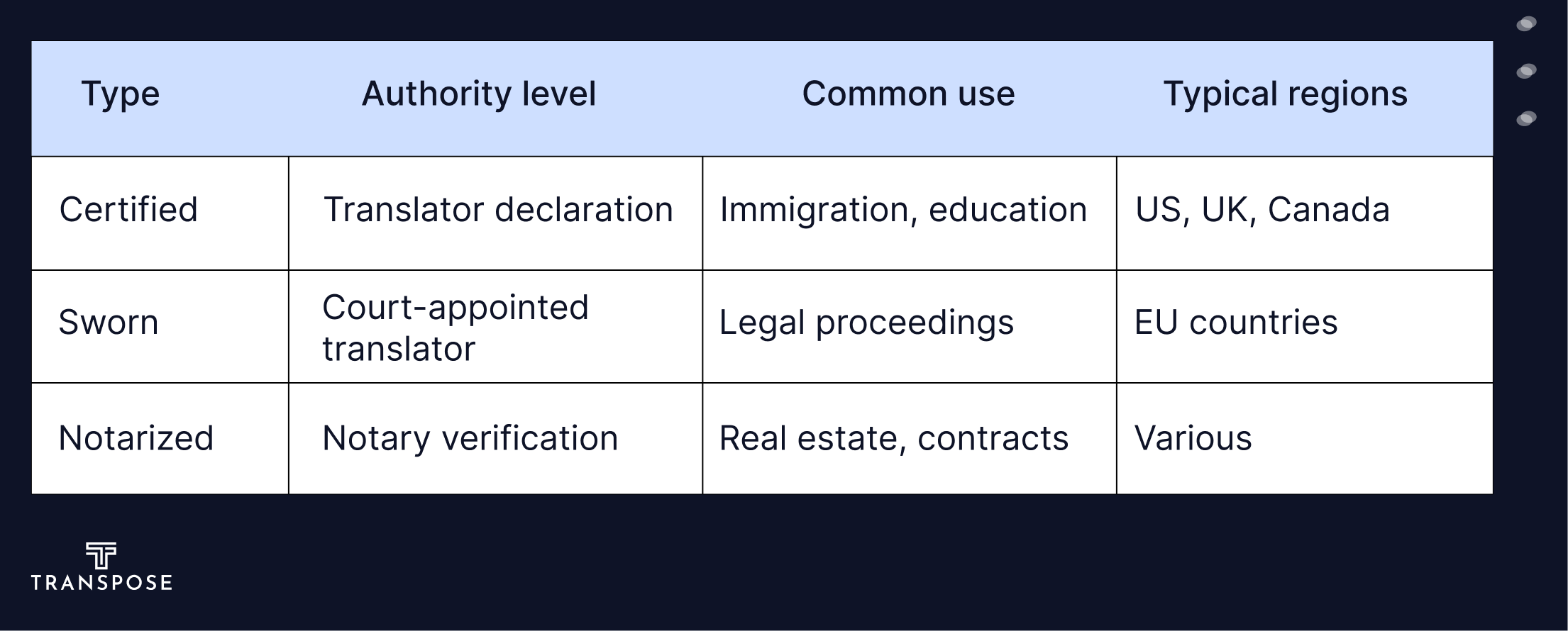
A certified translation comes with a signed statement from the translator confirming that the translation is accurate and complete. A sworn translation, however, is done by a translator who has been officially appointed or authorized by a court or government body and has taken an oath to provide legally valid translations.
A notarized translation adds another layer: a notary public verifies the translator’s identity and signature, but not the content of the translation itself.
Because requirements vary from country to country, your legal team should always confirm what type of translation is accepted—some jurisdictions recognize only sworn translations for court use. Knowing the differences helps you choose the right level of certification and avoid delays or rejections.
8. How much does certified translation cost?
The cost of certified translation depends on several factors: the type of document, language pair, word count or number of pages, and urgency or turnover time.
Because of these variables like, there is no universal fixed price for certified translations: it can be $0.10 to $0.60+ per word, or a flat fee of $20 to $150+ per page. Translation providers usually provide a quote after assessing the document.
Other factors also affect the cost of certified translation like source and target language combination, formatting complexity, and additional services like apostille or legalization.
9. How long does a certified translation take?
The turnaround time for a certified translation depends on several factors: the length and complexity of the document, the language pair, and the provider’s current workload. Short documents—like birth certificates or simple statements—can often be completed fairly quickly, while longer or more technical documents naturally take more time.
If the process includes extra steps such as notarization or legalization, you should expect additional processing time. It’s always a good idea to check timelines in advance, especially when your documents are needed for a strict deadline.
10. Can you get certified translation online
Yes, many professional translation agencies offer certified translation services entirely online through secure upload platforms. You can submit scanned documents, receive a quote, and download the certified translation without ever needing to visit a physical office.
Before sharing sensitive files, your legal or compliance team can review the agency’s credentials and security measures. Trusted providers use encrypted file transfers and follow strict confidentiality standards to protect your information when translating.
👉 You might also like to read: Why Switzerland's Data Protection Laws Make It the Safest Home for Corporate Translation
How the online certified translation process typically works:
- Upload clear scans or photos of your original documents
- Select the source and target languages
- Choose the certification type required by the institution
- Receive a quote and estimated turnaround time
- Approve the project and submit payment
- Download your certified translation along with the translator’s signed declaration
11. Who can provide certified translation?
Certified translations can be issued by professional translators, translation agencies, or court-appointed translators—depending on what your jurisdiction requires. The essential criteria are that the translator is fully competent in both languages and is able to certify that their work is accurate and complete.
For regulated industries or high-stakes documents, your procurement team should always review the translator’s credentials. Agencies certified under ISO 17100 follow standardized quality procedures, which helps ensure consistent and reliable translations.
Common indicators of a qualified translator include:
- Membership in professional associations (ATA, ITI, etc.)
- Relevant subject-matter expertise
- ISO certification for quality management
- A strong track record with similar document types
- Clear revision and quality assurance processes
12. Is certified translation legally binding?
A certified translation isn’t legally binding in the sense of creating new legal obligations, but it is considered an official and accurate representation of the original document. The certification statement makes the translator legally accountable for the translation’s accuracy, which is why it carries formal weight.
Because certified translations meet evidentiary standards in most jurisdictions, your legal team can rely on them for official proceedings. Courts, government agencies, and regulatory bodies generally accept certified translations as faithful equivalents of the original foreign-language documents.
13. Do certified translations expire?
Certified translations don’t technically expire, but many institutions set their own rules about how recent a translation must be. For example, immigration offices often require translations dated within the last 6–12 months, while universities or academic programs may accept older ones.
Before submitting an existing certified translation, your compliance team should confirm the latest requirements with the receiving authority. Some documents—like birth certificates—tend to remain valid for longer periods, while others, such as bank statements or medical records, may need more up-to-date translations.
14. Can machine translation be certified?
Absolutely not. Machine translation on its own cannot be certified. Certification requires a human translator to personally review the text and attest to its accuracy, which a machine cannot do. AI tools can certainly support the workflow, but they can’t replace the human responsibility attached to certification.
Your localization team can use machine translation to create initial drafts, but a qualified translator must edit, verify, and ultimately certify the final version. ISO 18587 standards outline best practices for properly post-editing machine-translated content.
15. How do you verify a certified translation?
A certified translation is verified by the translator or translation agency who issues a signed statement (affidavit) confirming accuracy, often with their credentials and contact info.
Verification checklist:
- Translator’s full name and signature
- Date the translation was completed
- A clear declaration stating the translation is accurate
- Company seal or stamp, if provided
- Reference or tracking number for agency records
- No visible edits, alterations, or handwritten corrections
16. What does a certified translation include or look like when it’s delivered?
A typical certified translation package usually contains:
- A certification statement (or “Certificate of Accuracy”) — signed and sometimes stamped or sealed by the translator or translation agency.
- The full translated document — formatted as closely as possible to the original, including layout, headings, and page numbers.
- The original document or a copy of the original — attached, bound, or included according to the agency’s procedure and the receiving authority’s requirements.
- Depending on your needs, the service may also provide a notarized version or add apostille/legalization steps. However, the core components remain the same: the signed certificate, the translation itself, and the original or a copy of the original document.
👉 Do you need to certify your documents for official use? Request a certified translation quote with your specific requirements and receive expert guidance on the right certification level for your needs.
For a tailored consultation or quote, email us at trp@transpose.ch or call +41 22 839 79 79 today.