
Imagine discovering that a loved one left you an estate or a piece of land in a beautiful foreign country. While this is often a gift, it can quickly turn into a stressful puzzle if the legal documents are in a language you do not speak. In our globalized world, families are often spread across different countries, meaning inheritance matters frequently cross borders.
When dealing with a foreign probate court, a bank abroad, or an international tax office, a simple "rough translation" will not work. Legal systems vary deeply between countries, and the documents that govern your rights must be translated with absolute precision to be legally valid.
This guide will help you understand the different types of translation services available and which one you need to secure your inheritance.
Why Does Translation Type Matter?
Inheritance documents, such as a Last Will and Testament, are the backbone of asset distribution. They contain specific legal terms that may not have a direct equivalent in another language. For example, certain English common law concepts do not exist in the civil law systems used in much of Europe.
If a translation is inaccurate, it can lead to family disputes, expensive litigation, or the rejection of your claim by foreign authorities. Therefore, choosing the right "type" of translation is a critical step in the probate process.
1. Certified Translation: The Official Standard
A certified translation is the most common requirement for inheritance claims and probate proceedings. In this type, the translator provides a literal, word-for-word rendition of the original document.
Key features of a certified translation include:
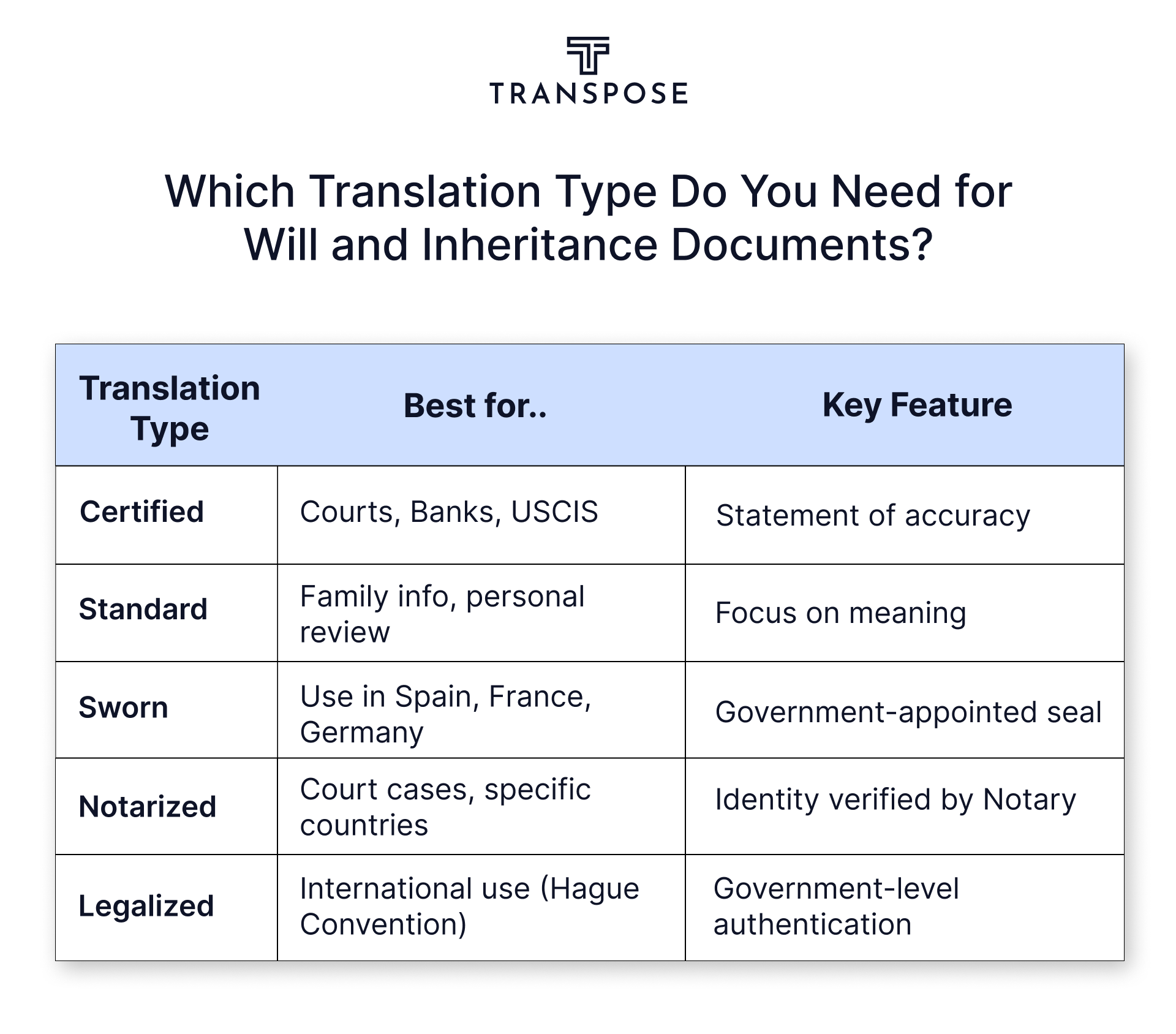
- A Statement of Accuracy: A signed and sometimes stamped letter from the translator or agency affirming that the translation is a true and complete representation of the original.
- Certification of Competence: The statement usually confirms the translator’s qualifications to perform the work.
- Formal Acceptance: These are generally required by probate courts, government agencies, and financial institutions to process claims and transfer assets.
2. Standard Translation: For Personal Clarity
A standard translation—also called an interpretive translation—is intended for personal use rather than official submission.
You might choose this type if:
- You simply need to understand the contents of a foreign will to communicate with family members.
- You are reviewing a draft of an estate plan with an advisor.
- The document is for "general understanding" and will not be filed with a court or bank.
Unlike certified versions, standard translations are often delivered in editable formats like Word documents and focus on conveying meaning rather than a strict word-for-word format.
3. Sworn Translation: The European Requirement
If your inheritance involves countries such as Spain, France, Italy, or Germany, you may specifically need a sworn translation. In these jurisdictions, only translators officially appointed and "sworn" by a government body or court are authorized to produce legally valid translations.
Sworn translators append their official seal and signature to the document, which grants it formal status before the national authorities of that specific country.
4. Notarized Translation: Verifying the Identity
Sometimes, a recipient will ask for a notarized translation. This is a certified translation where the translator signs the statement of accuracy in the presence of a Notary Public.
It is important to note that the Notary is not verifying the accuracy of the translation itself—they likely do not speak both languages. Instead, they are legally confirming the identity of the person signing the certification. This adds an extra layer of security often required for court cases or certain mortgage applications.
5. Apostille and Legalization: For Global Recognition
In many international probate cases, even a certified translation isn't enough. You may need an Apostille or legalization.
- Apostille: For countries that are part of the Hague Convention, this is a simplified certification that confirms the authenticity of the signature or seal on a public document.
- Legalization: For countries not in the Hague Convention, a multi-step process involving various government embassies is required to make the document admissible.
Often, you must have the original document apostilled first, and then have the document—including the apostille stamp—translated and certified.
Common Documents That Require Translation
When handling an estate, you will likely need a "document pack" translated together. Common documents include:
- The Will: The primary document outlining asset distribution.
- Death Certificate: Official proof of passing required to open estate proceedings.
- Birth and Marriage Certificates: Used to prove family relationships and the status of heirs.
- Grants of Probate / Succession Certificates: Documents that certify the status of the executor or heir.
- Financial Records: Bank statements, property deeds, and tax documents needed to calculate the estate's value.
How to Choose the Right Translation Service?
Selecting the right translation type depends on the "end user"—the person or office receiving the paper. To avoid delays, follow these steps:
- Ask the Recipient: Always check with the specific court, bank, or notary about their requirements (e.g., do they need a sworn translator or a specific notarization format?).
- Verify Expertise: Ensure the translator has experience in legal and inheritance law, as terminology errors can be costly.
- Check for Native Fluency: Professional translators should ideally be native speakers of the target language to ensure the tone and legal nuances are correct.
Summary Table: Which Translation Type Do You Need for Will and Inheritance Documents?
Managing the affairs of a loved one is already a difficult task. By ensuring you have the correct type of translation from the start, you can navigate the legal world with confidence and ensure that the legacy left behind is handled exactly as intended.
Request a quote for certified translation and receive your document with the exact certification level you need.
At Transpose, we craft precise, culturally attuned translations that ensure your content speaks directly to your audience. For a tailored consultation or quote, email us at trp@transpose.ch or call +41 22 839 79 79 today.